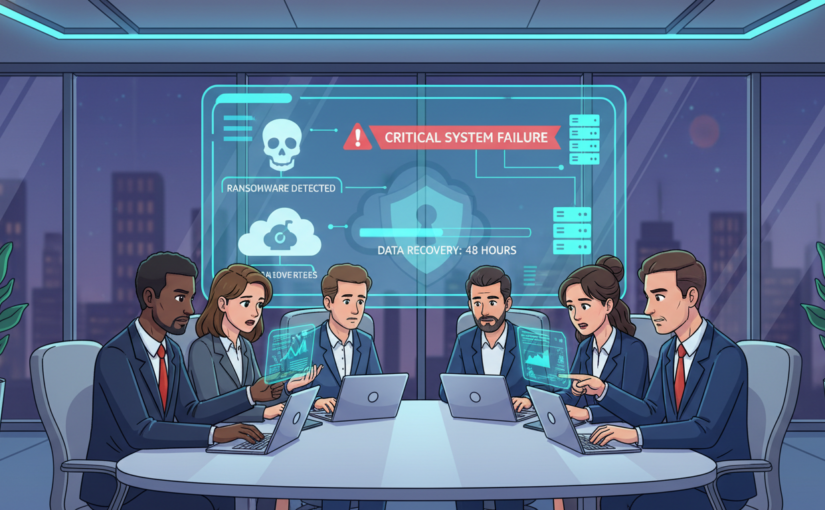
In today’s fast-paced digital world, our businesses face new threats. As we move key functions to the cloud, a strong ERP disaster recovery plan is crucial.
Modern hackers now target complex systems to demand ransom. This change makes ransomware protection B2B a key part of our defense.
We must protect our data to keep our operations running smoothly. By using a proactive defense strategy, we keep our systems safe and our stakeholders’ trust. This guide will show you how to strengthen your cloud against digital threats.
Key Takeaways
- Cloud-based systems need special security to fight off today’s cyber threats.
- Ransomware attacks are now aimed at core business management software.
- Keeping data safe is key to long-term business stability.
- Being proactive in defense helps us stay one step ahead of threats.
- Securing your systems protects your assets and keeps client trust.
Understanding ERP Disaster Recovery
We see our business systems as our main defense against digital threats. We create a plan to get back to normal quickly after disruptions. This keeps our operations running smoothly.
What is ERP Disaster Recovery?
ERP disaster recovery is about getting back to normal after big problems. It’s a set of steps and tools to help us start again fast.
This isn’t just about saving files. It’s about making a detailed plan for business survival. We prepare for the worst to keep our systems strong.
Importance of Disaster Recovery in ERP Systems
ERP systems are key to our business. Their uptime is crucial for our teams. If they fail, it affects everyone, from supply chains to finance.
Keeping data safe is vital to avoid long outages and big losses. This keeps our reputation strong and our stakeholders confident in us.
Investing in a strong recovery plan is smart. It keeps our data safe and reduces risks from digital threats. This is the start of building a strong system.
The Growing Threat of Ransomware
Today, businesses face a world where ransomware attacks are more complex and targeted. Gone are the days of random phishing attacks. Now, hackers focus on big targets, like cloud-based systems that manage a company’s operations.
Recent Trends in Ransomware Attacks
Attackers are now using cloud vulnerabilities to their advantage. They sneak into cloud systems, lock down important data, and freeze business operations. This calls for strong ransomware protection B2B strategies to keep up with these threats.
“The greatest threat to our security is the belief that someone else is responsible for it.”
Before they start encrypting data, hackers often spend weeks inside a network. They look for and disable backups, leaving victims with no choice but to pay. Proactive monitoring is now a must for any business to survive.
Impact of Ransomware on Businesses
Getting hit by ransomware does more than just ask for money. It can shut down operations for weeks, stopping production and disrupting supply chains. This can cost millions in lost sales and recovery efforts.
The damage to a company’s reputation can also be huge. Customers expect their data to be safe. A breach can destroy that trust quickly. A solid IT security policy is key to avoiding these problems.
By focusing on security, we can keep our businesses safe from relentless hackers. A good defense not only protects our data but also the future of our companies.
Cloud vs. On-Premises Disaster Recovery
The move to cloud-native environments is changing how we handle business continuity. We must compare the flexibility of remote systems to the control of local hardware. This is key for any business wanting to avoid unexpected downtime.
Benefits of Cloud ERP Solutions
Cloud-based platforms offer unmatched scalability and geographic redundancy. Traditional models can’t match this. Using a cloud ERP backup, our data stays accessible even if a primary data center fails. These systems have automated failover, quickly getting us back to normal after an incident.
Cloud environments also let us spread workloads across different regions. This diversity protects us from a localized disaster. We know our recovery is in the hands of experts with top-notch infrastructure.
Challenges of On-Premises Recovery Options
Traditional on-premises systems face high maintenance costs and physical risks. When a disaster hits, servers can be lost, causing long downtime and data loss. Relying on local hardware is risky, as it’s a single point of failure.
Managing these systems needs a strict IT security policy for consistent backups. Without it, recovery is slow and error-prone. A good IT security policy is crucial but hard to maintain with local hardware.
The table below shows the main differences between cloud and on-premises recovery:
| Feature | Cloud ERP Recovery | On-Premises Recovery |
|---|---|---|
| Scalability | High and Instant | Limited by Hardware |
| Maintenance | Managed by Provider | Internal IT Responsibility |
| Failover Speed | Automated and Fast | Manual and Slow |
| Cost Structure | Operational Expense | Capital Investment |
The shift to cloud-native environments is about speed and reliability. A solid cloud ERP backup strategy lets us focus on our business. By adopting these modern solutions, we protect our business from digital threats.
Key Components of a Disaster Recovery Plan
To build a strong enterprise, we need to understand key metrics for recovery success. When we plan for ERP disaster recovery, we focus on specific, measurable goals. These elements are crucial for keeping operations stable during unexpected issues.
Data Backup Procedures
A solid cloud ERP backup plan is essential. We make regular, automated database snapshots to keep data current and safe. Off-site storage helps protect our data from hardware failures or disasters.
Our backup practices include:
- Automate all backup schedules to avoid mistakes.
- Check data integrity with regular tests.
- Keep immutable copies to block ransomware.
- Encrypt data for maximum security.
Recovery Time Objective (RTO)
The Recovery Time Objective (RTO) is how long we can afford downtime. It tells us how fast we need to get systems back up. For example, if our RTO is four hours, we must restore critical functions within that time.
Setting a tight RTO means investing in extra infrastructure. We balance the cost of quick recovery with the financial hit of downtime. This metric is a critical benchmark for our IT team in emergencies.
Recovery Point Objective (RPO)
The Recovery Point Objective (RPO) deals with data loss. It’s the point in time we aim to restore data to. For example, an RPO of one hour means we aim to recover data from the last hour before the issue.
Good cloud ERP backup solutions help us achieve near-zero RPO. This means we can sync data in real-time. By matching our RPO with our business needs, we reduce the risk of losing important data. These metrics help us execute a successful ERP disaster recovery plan.
Developing Your Cloud ERP Disaster Recovery Strategy
Creating a strong plan for your cloud systems is key to staying resilient. We know that just reacting to threats isn’t enough anymore. A structured plan helps protect our important data and keeps our business running smoothly.
Assessing Vulnerabilities
Every good plan starts with checking your whole digital setup. We need to find out where our systems could fail. This careful check helps us see where we’re most at risk.
Knowing these risks is crucial for keeping our data safe during tough times. We examine every connection and data path carefully. This way, we know exactly what to protect most.
Establishing Clear Goals
After finding our risks, we set clear goals for recovery. These goals must match our business needs. ERP disaster recovery is a key part of our daily work.
We aim for specific times to get services back and data loss limits. These goals give us a clear aim for success. With clear goals, our team can act fast and with confidence in emergencies.
Engaging Stakeholders
A good plan needs support from IT and top leaders. We see ERP disaster recovery as a team effort. Getting key people involved early helps get the right support and funding.
This teamwork keeps our plan up-to-date as our business grows. When leaders see the value of enterprise data continuity, they’re more likely to support it. Together, we build a strong culture of readiness for the future.
Best Practices for Cloud ERP Disaster Recovery
We believe that a strong recovery plan evolves with your business. A static plan can’t keep up with today’s fast-changing cyber threats. By making your plan a living document, you keep your business safe from unexpected downtime.
Regular Testing and Updates
Even the best plans fail without regular testing. We suggest doing simulation exercises often to check if your cloud ERP backup works under stress. These tests find weaknesses before a real disaster hits.
It’s also key to keep your plan up to date. As your IT setup changes, your recovery plan must too. Regular reviews help avoid outdated plans that fail in emergencies.
Employee Training and Awareness
Technology is just half the battle; your team is the other. We stress the importance of training to prepare staff for disaster scenarios. A well-trained team is a strong defense against cyber threats.
When staff spots a potential breach, they can start recovery fast. This human factor cuts down the time to start fixing things. By teaching your team to be alert, you make your business more resilient against ransomware.
| Testing Activity | Frequency | Primary Goal |
|---|---|---|
| Tabletop Simulation | Quarterly | Validate team communication |
| Full System Restore | Bi-Annually | Verify cloud ERP backup integrity |
| Policy Audit | Annually | Ensure IT security policy alignment |
Recovery Options: Hot, Warm, or Cold Sites
Creating a strong disaster recovery plan means picking between hot, warm, and cold sites. Your company needs to weigh how quickly it must get back up against its budget. Each site type affects how quickly you can start again after a security issue.
Hot Sites for Immediate Recovery
A hot site is a full, mirrored version of your main ERP system. It’s ready to go at any time, thanks to real-time data sync. This is key for systems that can’t afford to be down for even a few minutes.
Hot sites keep your ransomware protection B2B plan ahead of problems. They’re the priciest option, but they offer quick recovery times. This is a big plus for big companies.
Cold Sites for Cost-Effective Solutions
For those on a tighter budget, a cold site is a good choice. These sites have the basics like power and cooling but no pre-set hardware or data sync. They’re cheaper because they’re not ready to go until needed.
They take longer to get up and running, but they’re still a solid part of a ransomware protection B2B plan. They’re best for systems that can handle longer downtime.
| Site Type | Recovery Speed | Cost Level | Complexity |
|---|---|---|---|
| Hot Site | Near-Instant | High | High |
| Warm Site | Hours | Moderate | Medium |
| Cold Site | Days | Low | Low |
Leveraging Automatization in Disaster Recovery
Automating your recovery workflows is the best way to keep your data safe during a crisis. Manual steps during a crisis can lead to errors, slowing down recovery. By taking out the human factor, we make our systems more stable and reliable.
Benefits of Automation in Recovery Processes
Automation cuts down recovery time dramatically. When a system fails, automated scripts start the recovery of your cloud ERP backup right away. This quick action is key to keeping downtime low and financial losses small.
Also, automation makes sure every recovery is consistent. We can set up exact steps that keep data safe, which is hard to do when teams are under pressure. This consistency is the heart of modern enterprise data continuity plans.
Tools for Effective Automation
Today’s companies use advanced orchestration platforms for complex, multi-cloud setups. These tools let us automate everything from initial backups to full system recovery. By using these tools, we can test our recovery plans often without affecting daily work.
The table below shows how manual recovery differs from automated recovery:
| Feature | Manual Recovery | Automated Recovery |
|---|---|---|
| Execution Speed | Slow and variable | Rapid and consistent |
| Error Probability | High due to stress | Negligible |
| Resource Demand | Requires expert staff | Low oversight needed |
| Testing Frequency | Rarely performed | Continuous and automated |
Vendor Selection for Cloud ERP Disaster Recovery
Choosing the right cloud ERP vendor is key to disaster recovery. It’s a critical decision that affects how well your organization can bounce back from a disaster. We need vendors who know how to protect against ransomware protection B2B to keep our business safe.

Criteria for Choosing Providers
We look for vendors with a strong track record in disaster recovery. They must support our ERP platform well and ensure a smooth failover. Scalability and having data in different places are also must-haves.
- Proven Uptime History: Choose providers known for being always available.
- Platform Compatibility: Make sure they work with your ERP system.
- Support Response Times: Check their SLAs for quick help in emergencies.
Evaluating Vendor Security Practices
It’s crucial to check a vendor’s security before you sign anything. We need to make sure their ransomware protection B2B meets our standards. This includes looking at their encryption, how they verify identities, and how they handle security incidents.
“Security is not a product, but a process that requires constant vigilance and partnership with trusted technology providers.”
We’ve made a table to help you compare vendors. It focuses on ransomware protection B2B and keeping your system safe.
| Evaluation Metric | High Priority | Standard |
|---|---|---|
| Security Certifications | SOC2 Type II / ISO 27001 | Basic Compliance |
| Ransomware Defense | Immutable Backups | Standard Encryption |
| Recovery Speed | Under 4 Hours | Under 24 Hours |
Our goal is to find a partner that sees your data security as their own. By doing our homework, we reduce risks and make sure our cloud ERP is ready for any challenge.
Compliance and Legal Implications
Compliance is more than just a formality; it’s the cornerstone of enterprise data continuity. When we create our recovery plans, we must focus on the legal rules that guide our field. This helps us avoid expensive fines and damage to our reputation.
Understanding Regulatory Requirements
Today’s businesses face strict rules from around the world and locally. Laws like GDPR, HIPAA, and SOC2 tell us how to manage and recover sensitive data when systems fail.
These rules aim to safeguard customer privacy and keep companies accountable. Not following them during a disaster can result in serious legal trouble and loss of customer trust.
“Compliance is the art of doing the right thing even when no one is watching, especially when your systems are down.”
Aligning Your DR Plan with Compliance Standards
To ensure enterprise data continuity, your recovery plan must match your compliance duties. We suggest doing a detailed gap analysis to see where your current methods don’t meet the rules.
Keeping detailed records of your recovery steps is key. This gives auditors the proof they need to confirm your operational maturity.
Keeping your disaster recovery plan up to date is crucial. It helps you stay in line with changing laws. This not only reduces legal risks but also shows your dedication to enterprise data continuity in every area.
Future Trends in ERP Disaster Recovery
Digital landscapes change fast, needing new ways to keep data safe. Enterprise systems face new risks that need better protection. Using the latest tools is key to safeguarding important business info.
Innovations on the Horizon
New tech like AI for threat detection and secure storage is coming. These tools help fight off advanced ransomware attacks. Adding these to your setup makes your data safer from unauthorized access.
Preparing for Future Threats
Creating a strong defense means thinking ahead about cyberattacks. Keeping your IT team up-to-date and flexible is crucial. Regularly check and update your IT security policy to stay ahead of threats.
By focusing on constant improvement, we ensure our ERP systems stay safe and running smoothly for the future.